

Every ancient pilgrimage site has more than one kind of history. One is found in architecture, records and traditions preserved over centuries. The other lives through sacred stories passed from one generation to another. At Kedarnath, these two are deeply connected. The story of this Himalayan shrine brings together the Pandavas, Lord Shiva, the Panch Kedar tradition and Adi Shankaracharya. Together, they form an important part of Kedarnath history and explain why the temple continues to hold such a special place in Hindu pilgrimage.
Kedarnath History and the Pandavas
One of the best-known traditions associated with Kedarnath begins after the great Kurukshetra war described in the Mahabharata. According to legend, the Pandavas were troubled by the bloodshed of the war. Seeking forgiveness and spiritual redemption, they wished to receive the blessings of Lord Shiva. Lord Shiva, however, did not immediately appear before them. Tradition says that Shiva took the form of a bull and hid in the Himalayan region. The Pandavas continued their search and eventually recognised him. When Lord Shiva was discovered, he disappeared into the earth. His hump is believed to have remained at Kedarnath, where it became associated with the form of Shiva worshipped at the temple today. Uttarakhand Tourism also records this legend as part of the traditional story of Kedarnath and the Panch Kedar shrines. Uttarakhand Tourism
Kedarnath History and the Panch Kedar Tradition
The story does not end at Kedarnath. According to the Panch Kedar tradition, different manifestations of Lord Shiva appeared at five sacred places in the Garhwal Himalayas.
They are:
- Kedarnath – associated with the hump
- Tungnath – associated with the arms
- Rudranath – associated with the face
- Madhmaheshwar – associated with the midsection or navel
- Kalpeshwar – associated with the hair or jata
Together, these five Shiva temples form the sacred Panch Kedar pilgrimage circuit. Uttarakhand Tourism. For devotees, therefore, Kedarnath is not an isolated shrine. It is part of a much wider sacred geography spread across the Himalayas.
The Story of Lord Shiva and the Sacred Bull
The image of the bull also has an important connection with Lord Shiva. Nandi, the sacred bull, is traditionally regarded as Shiva’s vahana, or divine vehicle, as well as his devoted attendant. At Shiva temples throughout India, Nandi is usually positioned facing the deity. Kedarnath follows this tradition, with Nandi facing the temple. Against the vast Himalayan landscape, this familiar symbol of devotion takes on an especially powerful presence.
Kedarnath Temple History Through the Centuries
The exact early history of Kedarnath Temple cannot be separated completely from religious tradition. The Pandavas are traditionally associated with the shrine, while later tradition connects the revival of the temple and pilgrimage with Adi Shankaracharya. What can be seen today is an extraordinary stone temple standing in one of India’s most dramatic mountain environments. The temple is constructed from large stone slabs and stands at an altitude of about 3,580 metres in the Garhwal Himalayas. It is dedicated to Lord Shiva and is also revered as one of India’s 12 Jyotirlingas. Uttarakhand Tourism. Its architecture is striking partly because of its simplicity. There are no elaborate city streets or huge urban structures surrounding the shrine. Instead, towering Himalayan peaks provide its backdrop. That setting is part of what makes Kedarnath unlike almost any other major pilgrimage site in India.
Adi Shankaracharya’s Place in Kedarnath History
Another important chapter in Kedarnath history is its association with Adi Shankaracharya. The philosopher and spiritual teacher is traditionally credited with strengthening and revitalising important centres of Hindu learning and pilgrimage across India. Kedarnath holds a particularly strong association with him. Tradition holds that Adi Shankaracharya attained moksha near Kedarnath after an extraordinarily influential yet relatively short life. A memorial dedicated to him stands just behind Kedarnath Temple, and Uttarakhand Tourism describes the location as the place where he is believed to have attained moksha. Uttarakhand Tourism His association with Kedarnath adds another dimension to the shrine. The story is no longer only about the Pandavas seeking Lord Shiva. It is also about centuries of teachers, saints and pilgrims who continued to travel into the Himalayas in search of spiritual understanding.
Kedarnath Temple and the Himalayan Setting
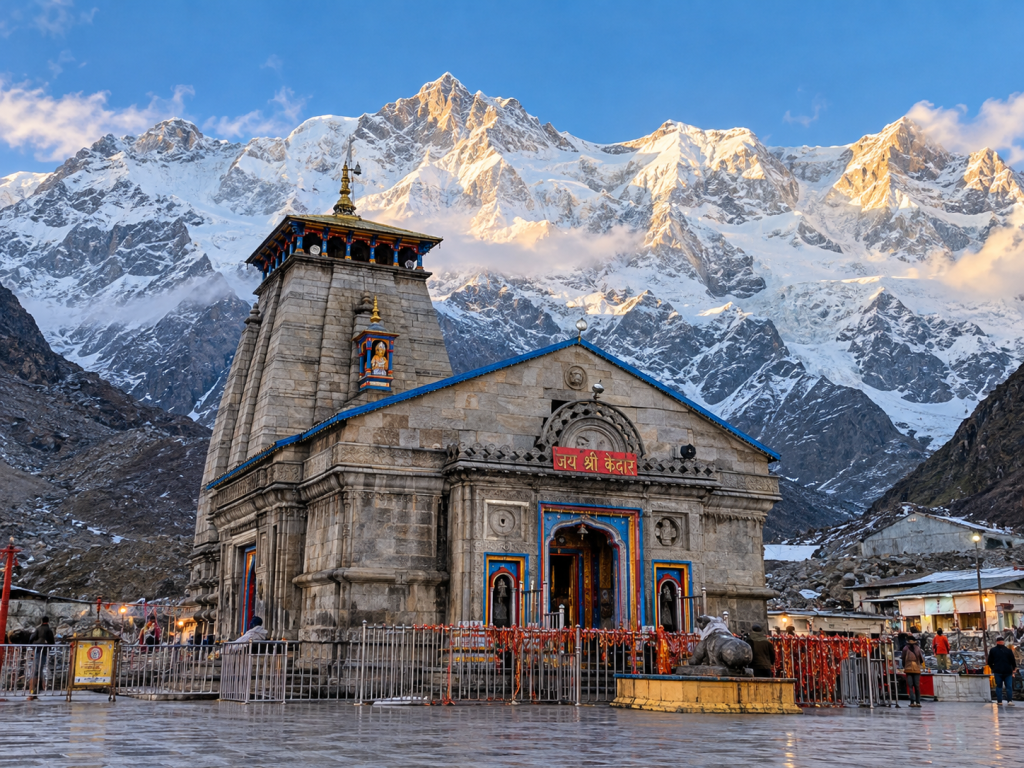
Perhaps one reason Kedarnath history still feels so alive is its setting. Reaching Kedarnath requires pilgrims to travel deep into the Garhwal Himalayas. Even today, the final approach involves a mountain journey from Gaurikund towards the shrine. Along the way, pilgrims encounter steep valleys, rivers, waterfalls, changing weather and towering mountains. The physical journey creates a natural separation from everyday life. By the time the temple finally appears against the mountains, the pilgrimage can feel like much more than simply arriving at a destination.
How Kedarnath’s Spiritual Legacy Continues
It is easy to think of ancient legends as stories belonging only to the distant past. Pilgrimage, however, keeps these traditions alive. When grandparents tell their grandchildren about the Pandavas and later walk towards Kedarnath themselves, the story continues. When pilgrims chant Om Namah Shivaya while making their way through the mountains, the story continues. When someone returns home from the Himalayas and tells a friend, “You should visit Kedarnath at least once in your lifetime,” the story continues again. That may be one of the most remarkable things about Kedarnath. Its traditions are ancient. Its temple has welcomed generations of pilgrims. Its mountains have witnessed centuries of devotion. Yet the story of Kedarnath is not finished. Every pilgrim who makes the journey becomes a small part of its continuing history.
You May Also Like
The Spiritual Significance of Kedarnath
- Kedarnath Yatra Guide: Everything You Need to Know Before You Go
- Kedarnath Trek Guide: Gaurikund to Kedarnath Step by Step
